

Retatrutide has drawn a lot of attention in research and wellness conversations. Many headlines focus on big early findings, but it helps to slow down and look at what the studies actually say.
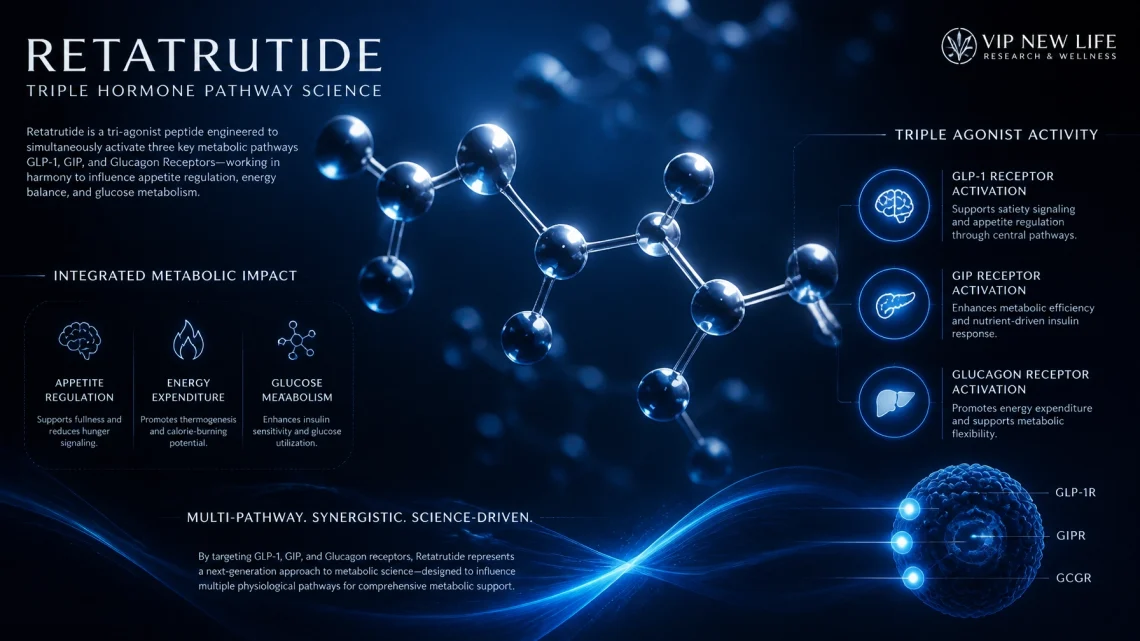
In simple terms, retatrutide is an investigational peptide-based molecule being studied because it interacts with three important signaling pathways in the body: GLP-1, GIP, and glucagon. That makes it different from compounds that act on only one or two of these pathways.
Research Use Only statement: As of August 2026, retatrutide is not FDA-approved and is not approved for general clinical use. It remains an investigational compound under study. This article is provided for educational purposes and Research Use Only discussion.
What Is Retatrutide?
Retatrutide, also known by the research code LY3437943, is described in published research as a triple receptor agonist.
That phrase sounds technical, but the basic idea is simple. An agonist is a compound that turns on a receptor. A receptor is like a message receiver in the body. When a receptor is activated, it can change how the body handles signals related to hunger, blood sugar, or energy use.
Retatrutide is being studied because it activates three pathways at the same time:
- GLP-1, or glucagon-like peptide-1
- GIP, or glucose-dependent insulinotropic polypeptide
- Glucagon
Researchers are interested in whether combining these three signals in one molecule creates a different metabolic response than working through just one pathway alone.
That does not mean the research proves the same outcome for every person. Clinical trials measure what happens in specific study groups under controlled conditions. They do not provide a personal-use plan.
Why Are Researchers Interested?
Researchers are interested in retatrutide mainly because it works across three pathways instead of one.
The body does not manage hunger, blood sugar, and energy use through a single switch. These systems overlap. That is why researchers want to know what happens when GLP-1, GIP, and glucagon signals are activated together.
Early clinical research has looked at areas such as:
- Body-weight changes
- Blood glucose and HbA1c
- Appetite-related signals
- Liver fat
- Blood lipids
- Visceral and abdominal fat
- Cardiometabolic markers
- Safety and tolerability
One widely discussed study was a 2023 phase 2 trial published in the New England Journal of Medicine. It studied retatrutide in adults with overweight or obesity and reported substantial average body-weight reductions in some study groups over 48 weeks.
That phase 2 study remains important historical context. Since then, the research has moved forward. In May 2026, Lilly reported Phase 3 TRIUMPH-1 topline results. In July 2026, the company also reported positive Phase 3 topline results from TRIUMPH-2 and TRIUMPH-3. These updates show that retatrutide research has advanced into larger late-stage studies, but they do not mean approval has been granted, is close, or is guaranteed. Retatrutide remains investigational and not FDA-approved, and other Phase 3 and longer-term studies are still ongoing.
Read the published phase 2 obesity study in the New England Journal of Medicine.

Understanding the GLP-1, GIP, and Glucagon Combination
GLP-1: A Signal Linked to Fullness and Blood Sugar
GLP-1 is a natural hormone your body makes, especially after you eat. In simple terms, it helps the body send messages related to feeling full and handling blood sugar after meals.
Researchers often study GLP-1 in connection with:
- Appetite signals
- Insulin release when glucose is present
- How quickly food moves through the stomach
- Blood sugar regulation after eating
If the phrase glucose-dependent sounds overly technical, it simply means the signal is influenced by glucose levels rather than acting the same way at all times.
GIP: A Signal That Helps the Body Respond to Food
GIP is another natural hormone released after eating. It is part of the body’s built-in meal-response system.
Researchers study GIP in relation to:
- Insulin response after meals
- How the body handles nutrients
- Energy storage and energy use
- How it works alongside GLP-1
GIP is not just a copy of GLP-1. It has its own job and its own receptor, which is one reason researchers are interested in combining the two signals.
Glucagon: A Signal Related to Stored Energy
Glucagon is another natural hormone. It is often described as helping the body access stored energy.
In retatrutide research, scientists are looking at whether glucagon receptor activity may be related to:
- Energy release
- Fat metabolism
- Energy expenditure
- Liver fat regulation
This is also why retatrutide is not best described as simply a “stronger GLP-1.” It is better understood as a molecule designed to activate three different but connected signals.
What Makes Retatrutide Different?
What makes retatrutide stand out in research is its three-part design.
Some compounds are studied for one signaling pathway. Others are studied for two. Retatrutide is being studied for three: GLP-1, GIP, and glucagon.
That leads researchers to a broader question:
> What happens when several metabolic signals are activated together?
That question matters because metabolism is influenced by many factors, not just one. Hunger, blood sugar, energy use, sleep, stress, activity, and individual biology can all affect what researchers observe.
It is also important to stay balanced. More pathways do not automatically mean a better outcome. They simply create a different and more complex research picture.
What Has the Research Reported So Far?
Published research and company-reported topline updates have now reported findings in several areas.
As historical context, phase 2 research drew much of the early attention. In an obesity study, researchers observed significant average body-weight changes over the study period. They also looked at measurements such as waist circumference, blood pressure, blood glucose, and blood lipids.
A separate phase 2 trial in adults with type 2 diabetes examined HbA1c and body-weight changes. HbA1c is a common lab marker that reflects average blood sugar over time. In that study, several retatrutide groups showed improvements in these measured outcomes compared with placebo. Reported adverse events included gastrointestinal effects such as nausea, diarrhea, vomiting, and constipation.
Researchers have also studied retatrutide in metabolic dysfunction-associated steatotic liver disease, or MASLD, a condition involving excess fat in the liver. In that study, magnetic resonance imaging, or MRI, was used to measure liver fat. The study reported reductions in liver fat along with changes in other metabolic measurements.
More recently, Lilly reported Phase 3 topline results from TRIUMPH-1 in May 2026 and positive topline results from TRIUMPH-2 and TRIUMPH-3 in July 2026. These are sponsor-reported updates from larger studies, which is different from peer-reviewed published journal research. They are important to follow, but they should still be read carefully and in context.
These findings are scientifically important, but they are still research findings. They do not mean retatrutide is approved to treat obesity, type 2 diabetes, liver disease, or any other condition. More research is still needed, especially on long-term outcomes.
Review the published MASLD study in Nature Medicine.
What Is Still Unknown?
Current research has reported notable findings in several areas, but important questions remain.
Researchers are still studying:
- Long-term safety over multiple years
- Rare or delayed adverse events
- How long observed changes last
- What happens after discontinuation
- Effects in different populations
- Cardiovascular and kidney outcomes
- Lean mass and body-composition changes
- Long-term liver outcomes
- Why some people may respond differently than others
Phase 2 studies helped identify early patterns. Several Phase 3 TRIUMPH studies have now reported topline results, while additional retatrutide Phase 3 and longer-term studies continue to evaluate other populations, outcomes, safety questions, durability, and longer-term effects.
Phase 3 results do not mean regulatory approval has been granted, is close, or is guaranteed. Retatrutide remains investigational and is not currently FDA-approved. Trial information and study status can be reviewed through ClinicalTrials.gov and sponsor materials.
Research Use Only: What That Means
Research Use Only, or RUO, refers to the intended status and use of applicable research products.
This article is an educational discussion of published research and company-reported study updates. It is meant to help you understand what researchers are studying, what has been reported so far, and what still remains uncertain.
It does not provide dosing, protocols, treatment recommendations, medical advice, or permission for human use.
VIP New Life does not diagnose, treat, prescribe, recommend dosing, or provide medical advice. All applicable research products are intended for laboratory research purposes only. They are not intended for human consumption or for the diagnosis, treatment, cure, or prevention of any disease.
Transparency Supports Informed Decisions
Clear documentation helps researchers and customers understand what a product is intended for and what information is available.
You can also explore:
A Certificate of Analysis, or COA, may provide information such as product identity, purity, batch details, and testing documentation for applicable research products. Reviewing documentation is one way to support responsible research and informed decisions. A COA does not change a product’s Research Use Only status or establish approval for human use.
Beyond the Headlines
The most balanced way to understand retatrutide is to keep two ideas in mind at the same time.
First, the research is meaningful. A single molecule that interacts with GLP-1, GIP, and glucagon gives researchers a way to study several connected metabolic signals together.
Second, there is still a great deal to learn. Retatrutide is investigational, not FDA-approved, and still being studied. Early results can help guide future research, but they do not answer every question.
At VIP New Life, our goal is to make complex topics easier to understand. We believe informed decisions begin with education, transparency, responsible research, and ongoing support.
For additional discussion, VIP New Life is also covering this subject through our “Retatrutide: Beyond the Headlines” educational series on social media. Follow along on Instagram and Facebook.
Research and Further Reading
Peer-reviewed published research
- Phase 2 obesity study in the New England Journal of Medicine
- Phase 2 type 2 diabetes study on PubMed
- MASLD study in Nature Medicine
Sponsor-reported Phase 3 topline results
Trial registry information
Important notice: This article is for general education and Research Use Only discussion. Retatrutide is investigational and is not currently FDA-approved. Nothing in this article is medical advice, a diagnosis, a treatment recommendation, a prescription, a dosing instruction, or a claim that retatrutide diagnoses, treats, cures, or prevents any disease. Applicable research products are intended for laboratory research purposes only and are not intended for human consumption.